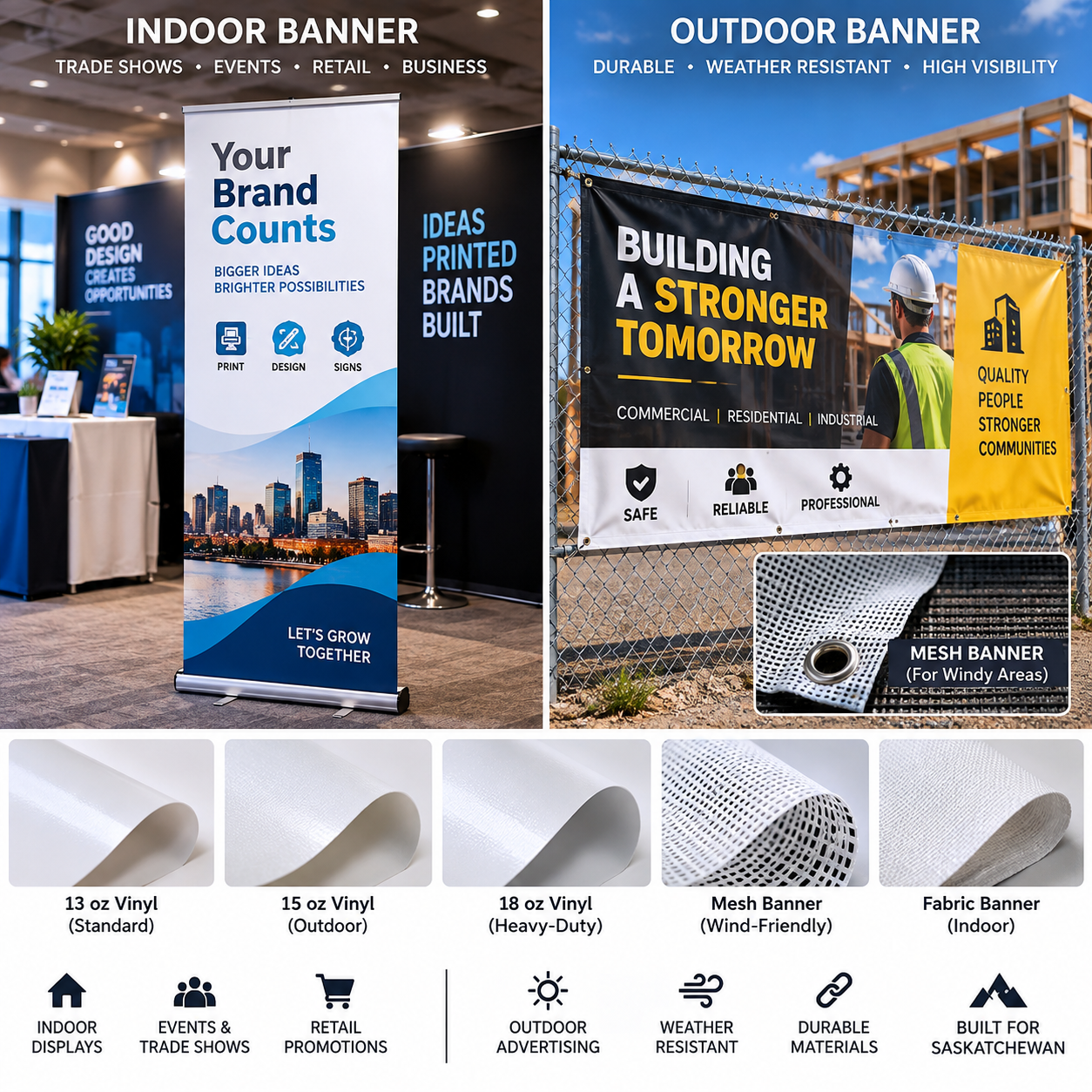
A banner can be one of the simplest and most effective ways to promote a business, event, grand opening, construction project, community program or special offer.
But choosing a banner involves more than deciding on a size and sending a logo to the printer.
A banner hanging inside a trade show booth has very different requirements from a banner attached to an outdoor fence in Saskatchewan. Material strength, wind, sunlight, mounting, print colour, viewing distance and length of use should all be considered before production.
This guide explains the differences between indoor and outdoor banners and how to choose an appropriate material and design for your project.
What Is the Difference Between an Indoor and Outdoor Banner?
The biggest difference is the environment in which the banner must perform.
An indoor banner normally does not have to deal with rain, snow, strong wind or extended exposure to direct sunlight. This gives you more flexibility with lightweight materials and display systems.
An outdoor banner needs to withstand considerably more stress. The material, mounting points and installation method therefore become much more important.
Common Indoor Banner Uses
Indoor banners are commonly used for:
- Trade shows
- Conferences
- School events
- Business presentations
- Retail promotions
- Reception areas
- Community events
- Stage backdrops
- Restaurant promotions
- Exhibitions
- Photo areas
- Indoor directional signage
Because there is little wind or weather exposure, the main priorities are normally appearance, portability and image quality.
Common Outdoor Banner Uses
Outdoor banners are frequently used for:
- Storefront advertising
- Grand openings
- Construction sites
- Fences
- Sports events
- Festivals
- Real-estate promotions
- Community events
- Outdoor sales
- Temporary business signage
- Building promotions
For these applications, the banner must be selected with weather and installation conditions in mind.
What Is Vinyl Banner Material?
Vinyl is one of the most common materials used for commercial banners.
Many vinyl banners contain an internal reinforcing scrim, usually a woven structure that adds strength to the material. This is why you may hear terms such as scrim vinyl, PVC banner or simply vinyl banner.
The solid printable surface allows strong colour, photographs, logos and large text to reproduce clearly.
Vinyl is popular because it provides a useful combination of durability, print quality, flexibility and cost.
What Does 13 oz Banner Mean?
Banner material is often described by weight, such as 13 oz, 15 oz or 18 oz.
The measurement describes the approximate weight of the material rather than the physical dimensions of the finished banner.
13 oz vinyl is one of the most widely used general-purpose banner materials.
It can be suitable for:
- Indoor banners
- Temporary outdoor advertising
- Events
- Storefront promotions
- Sales banners
- Community events
- Trade shows
It is relatively lightweight while still providing a durable solid surface for full-colour printing.
What Is 15 oz Vinyl?
Some banner manufacturers offer a 15 oz material specifically positioned for outdoor applications.
It provides additional weight and strength compared with lighter indoor-oriented materials while maintaining the smooth appearance of a solid vinyl banner.
Banner weights and constructions vary between manufacturers, so the actual material specification is more important than the number alone.
What Is 18 oz Heavy-Duty Vinyl?
18 oz vinyl is a heavier material commonly used when additional strength, opacity or longer-term outdoor performance is desired.
Depending on the product, heavy-duty vinyl may also include blockout construction that prevents light or graphics from showing through from the opposite side.
It can be considered for:
- Longer-term outdoor displays
- Large banners
- Commercial applications
- Double-sided banner systems
- Locations where additional material strength is useful
A heavier banner is not automatically the correct choice for every outdoor installation. Wind load and mounting can matter more than simply increasing material weight.
What Is a Mesh Banner?
Mesh banner material contains thousands of small openings that allow some air to pass through the banner.
This reduces the amount of wind pressure placed on the banner and its mounting points.
Mesh is especially useful for:
- Construction fencing
- Large outdoor fences
- Scaffolding
- Sports venues
- Festivals
- Open outdoor areas
- Locations exposed to regular wind
The trade-off is print appearance. Because part of the surface contains openings, colours and photographs can look slightly less solid than they would on non-perforated vinyl.
Solid Vinyl or Mesh?
If image quality, rich colour and opacity are the main priorities, solid vinyl is generally the better choice.
If the banner will cover a large fence or be installed in a location where wind can place significant pressure on the material, mesh may be more appropriate.
A solid banner can behave almost like a sail when wind pushes against a large uninterrupted surface.
Mesh helps reduce this pressure by allowing airflow through the material.
Is Mesh Automatically Safe in Strong Wind?
No banner should be considered immune to severe weather.
Mesh reduces wind load, but the structure, mounting hardware and installation still need to be suitable for the location.
Large temporary banners should be removed when severe weather or unusually high winds are expected whenever practical.
What About Fabric Banners?
Fabric banners can produce an elegant, less reflective appearance and are especially popular for indoor displays.
They can work well for:
- Trade shows
- Corporate events
- Stage displays
- Photography backgrounds
- Indoor retail environments
- Presentation spaces
Fabric and vinyl produce noticeably different appearances. Fabric can feel more like a display or backdrop, while vinyl usually provides the durability and easy maintenance associated with commercial signage.
Indoor Banner Material: What Should You Choose?
For most indoor projects, durability against weather is not the main concern.
You can therefore choose the material based primarily on:
- Appearance
- Lighting
- Portability
- Display system
- Budget
- How frequently the banner will be reused
A standard vinyl banner works well for many indoor promotions. Fabric can be attractive for presentations or backdrops, while retractable banners provide a portable freestanding system for trade shows and business events.
Outdoor Banner Material: What Should You Choose?
For outdoor applications, first consider the location.
Ask:
- Will the banner be attached to a wall or fence?
- Is the location protected or exposed?
- Will wind hit the full surface?
- How large is the banner?
- How long will it remain outside?
- Will it receive direct sunlight?
- How securely can it be mounted?
Standard scrim vinyl can work very well for many temporary outdoor applications.
For particularly large or exposed fence installations, mesh should be considered because of its ability to allow air to move through the material.
Banner Quality Is More Than Material Weight
Customers sometimes assume that the heaviest banner must automatically be the highest quality.
That is not necessarily true.
Banner performance depends on several factors:
- Material construction
- Internal scrim strength
- Ink and printing technology
- Edge finishing
- Grommet quality and placement
- Installation method
- Banner size
- Weather exposure
- Storage and reuse
A correctly selected and installed standard vinyl banner can perform better than a heavier banner that has been installed incorrectly.
What Are Grommets?
Grommets are reinforced metal eyelets installed around a banner so rope, hooks, cable ties or other mounting hardware can pass through the material.
They make installation easier and help distribute tension across the banner.
The number and spacing of grommets should match the banner size and installation method.
For outdoor banners, using only the corner grommets on a long banner can place excessive stress on those four locations.
What Is a Banner Hem?
A hem reinforces the outside edge of a banner by folding or reinforcing the perimeter.
Some banner-production workflows use welded or sewn hems to increase edge strength.
Finishing options vary by print provider, so confirm what is included before ordering if a particular installation requires hems, pole pockets or other specialty finishing.
What Are Pole Pockets?
A pole pocket is a sleeve created along an edge of the banner so a pole or rod can slide through it.
This is useful for certain:
- Stage banners
- Street displays
- Hanging banner systems
- Trade show displays
Again, the required finishing should be determined before the artwork is finalized because pole pockets can affect the usable design area.
Single-Sided or Double-Sided Banner?
A single-sided banner is intended to be viewed primarily from one direction.
This is appropriate when it will be:
- Mounted against a wall
- Attached to a solid fence
- Placed on the front of a building
- Displayed behind a table
A double-sided banner is intended for locations where people approach from both directions.
Double-sided banners typically require a more opaque or blockout material so the design on one side does not interfere with the other.
Choosing Colours for a Banner
A banner is normally viewed from farther away than a flyer or business card.
This means colour should be selected for visibility first.
Strong contrast usually works better than using many similar colours.
Examples of high-contrast combinations include:
- Black and white
- Dark blue and white
- Yellow and black
- Red and white
- Dark green and white
- White text on a dark photograph
The exact colours should still match the company's branding whenever possible.
Avoid Using Too Many Colours
A banner does not need every colour available in the design software.
Using too many colours can make the message harder to understand from a distance.
A strong banner often uses:
- One primary brand colour
- One contrasting background or text colour
- One accent colour
Additional colours can be used in photography, but the main message should remain visually clear.
Why Screen Colours Can Look Different in Print
Your phone, monitor and television create colour using RGB light.
A printed banner uses physical inks on a material surface.
Some extremely bright RGB colours cannot be reproduced exactly by a printing system, so colour conversion may produce a slightly different result.
This is particularly noticeable with some neon blues, greens and highly saturated colours.
If exact brand colour is important, provide proper brand colour information and discuss colour expectations before printing.
Should Banner Artwork Be RGB or CMYK?
There is no single answer that applies to every large-format printer.
Some large-format printers use more than four physical inks and their RIP software can process properly prepared RGB artwork very effectively.
Other production workflows may request CMYK or a specific colour profile.
The safest approach is to follow the print provider's artwork requirements instead of converting a file into a random CMYK profile.
What Colours Work Best Outdoors?
Outdoor banner colour needs to remain understandable under different lighting conditions.
Remember that the banner may be viewed:
- In strong sunlight
- In shade
- On a cloudy day
- From inside a vehicle
- From across a parking lot
A subtle low-contrast design that looks elegant on a laptop can become difficult to read outside.
For outdoor signage, bold separation between the background and important text is normally more effective.
Keep the Banner Message Simple
One of the most common banner-design mistakes is trying to fit an entire brochure onto a large sign.
A person walking or driving past may only have a few seconds to understand the message.
Prioritize:
- Business or event name
- Main message
- Important date or offer
- Phone number or website if necessary
- Logo
Everything else is secondary.
Use Large, Readable Fonts
A banner may be several feet wide, but that does not mean small text will suddenly become readable from far away.
The farther away the audience is, the larger the important text needs to be.
Avoid:
- Very thin fonts
- Long paragraphs
- Small contact information
- Low-contrast type
- Complicated decorative lettering for essential information
Test the artwork by viewing it smaller on your screen. If the main message disappears when the design is reduced, it may also be difficult to understand from a distance.
How Large Should a Banner Be?
The correct banner size depends on the available space and how far away the audience will be.
A banner behind a registration table may only need to be read from a few metres away.
A banner attached to a building or construction fence may need to be understood from across a street or parking lot.
Common banner proportions include:
- 2 ft × 4 ft
- 2 ft × 6 ft
- 3 ft × 6 ft
- 3 ft × 8 ft
- 4 ft × 8 ft
- Custom sizes
These are only examples. Custom dimensions can often be produced depending on the printer and material width.
Large Banner Design Is Different From Flyer Design
A flyer is held in the hand and can contain detailed information.
A banner usually needs to communicate from a distance.
This means a successful banner normally contains:
- A strong headline
- A simple image or graphic
- A clear logo
- Large text
- Minimal supporting information
- Strong colour contrast
What Resolution Should Banner Artwork Be?
Large-format printing does not always require the same effective image resolution as a small brochure or business card.
A banner is normally viewed from farther away, so the required resolution depends on final size and viewing distance.
However, this does not mean a small image downloaded from a website can automatically be enlarged to several feet wide.
Start with the highest-quality original images available and keep logos and typography as vector artwork whenever possible.
Use Vector Logos for Large Banners
A vector logo can be enlarged without becoming pixelated.
Preferred formats can include:
- AI
- EPS
- SVG
- Properly created vector PDF
A tiny JPG copied from a website may look acceptable at two inches wide but can become visibly blurry when enlarged to two feet.
How Should You Prepare a Banner PDF?
For professional printing:
- Use the correct banner dimensions or clearly identify the artwork scale.
- Keep logos and text as vector where practical.
- Use high-quality images.
- Embed fonts or export them properly.
- Do not add unnecessary crop marks unless requested.
- Follow the printer's colour and PDF requirements.
- Keep important content away from edges, grommets and finishing areas.
How Long Does an Outdoor Banner Last?
There is no guaranteed lifespan that applies to every outdoor banner.
Longevity depends on:
- Material quality
- Ink system
- Amount of direct sunlight
- Wind exposure
- Temperature
- Banner size
- Installation
- How frequently the banner is taken down
- Storage between uses
Commercial vinyl banners can often be reused for multiple events when they are properly installed, handled and stored.
How to Make a Banner Last Longer
- Use the correct material for the location.
- Secure the banner properly instead of allowing it to flap continuously.
- Use enough mounting points to distribute tension.
- Do not stretch the material excessively.
- Remove temporary banners during extreme weather when possible.
- Keep sharp objects away from the material.
- Roll the banner for storage rather than creating hard folds when possible.
- Store it clean and dry.
Should You Fold or Roll a Vinyl Banner?
Rolling is generally preferable for storage.
Repeated folding can create creases that may remain visible when the banner is displayed again.
If you plan to reuse a banner for annual events or recurring promotions, proper storage can make a noticeable difference.
Indoor vs Outdoor Banner: Quick Comparison
| Requirement | Indoor | Outdoor |
|---|---|---|
| Weather resistance | Usually less important | Important |
| Wind | Normally minimal | Can be a major consideration |
| Material | Vinyl, fabric or display material | Solid vinyl, heavy-duty vinyl or mesh |
| Image quality | High detail can be important | Visibility and contrast are especially important |
| Viewing distance | Often closer | Often farther away |
| Mounting | Wall, stand, hooks or display system | Secure mounting designed for the location |
| Best design style | Can contain somewhat more detail | Large, simple and high contrast |
When Should You Choose a Retractable Banner?
A retractable banner is different from a traditional hanging vinyl banner.
The printed graphic rolls into a portable base and can be set up without attaching the banner to a wall or fence.
Retractable banners are particularly useful for:
- Trade shows
- Business presentations
- Hotel events
- Conferences
- Reception areas
- Registration desks
- Indoor promotions
They are easy to transport and provide a professional vertical display.
What Type of Banner Is Best for a Business?
Choose based on where the banner will actually be used.
Indoor event: Standard vinyl, fabric or retractable display.
Storefront promotion: Solid vinyl works well where wind exposure is manageable.
Outdoor fence: Solid vinyl may work in protected conditions, while mesh should be considered for large or wind-exposed installations.
Longer-term heavy-duty use: Consider heavier outdoor vinyl and an appropriate installation system.
Trade show: Retractable or fabric displays can provide a cleaner presentation and easy transportation.
Banner Printing in Regina, Saskatchewan
Horizon Hub provides custom banner design and printing in Regina for businesses, organizations, events and community projects.
Our banner projects can include full-colour scrim vinyl for indoor and outdoor promotional use, with custom sizing and grommet options depending on the project.
Banners can be prepared for:
- Grand openings
- Business promotions
- Storefronts
- Construction projects
- Community events
- Schools
- Sports events
- Restaurants
- Trade shows
- Fundraisers
- Religious and community organizations
Do You Need a Banner Design?
If you do not already have print-ready artwork, Horizon Hub can also help prepare the banner design.
For a professional result, we consider the physical banner size, viewing distance, logo quality, brand colours and the amount of information people actually need to see.
If you already have artwork, send us the print-ready PDF and requested finished size so it can be reviewed before production.
Final Advice
The right banner is not simply the thickest or most expensive option.
A good banner matches the environment.
For an indoor trade show, visual quality and portability may matter most. For a storefront, solid vinyl can provide excellent colour and visibility. For a large outdoor fence exposed to wind, mesh may be the more appropriate material.
The same principle applies to the design: banners are made to be seen from a distance. Use strong contrast, large text, good-quality artwork and a simple message.
If you need indoor or outdoor banner printing in Regina, Saskatchewan, Horizon Hub can help you determine the size, artwork and banner setup appropriate for your project.