Choosing a printing method for custom T-shirts can be confusing because several technologies can produce a good-looking result. DTF, HTV, screen printing, DTG and sublimation are all commonly used, but each method has different strengths.
The best choice depends on the garment, artwork, quantity, colours, intended use and the finish you want.
This guide explains the differences so you can choose a method that makes sense for your project instead of simply choosing whichever printing method is most familiar.
What is DTF printing?
DTF stands for Direct-to-Film printing. The artwork is printed onto a special transfer film using dedicated inks. A powdered adhesive is applied to the printed design, and the finished transfer is then heat-pressed onto the garment.
One of the biggest advantages of DTF is versatility. It can be used on many common apparel materials and colours, including black and other dark garments.
DTF also handles detailed logos, gradients, photographs and multi-colour artwork very well without requiring a separate layer for every colour.
How long does DTF printing last?
A properly produced and correctly applied DTF transfer can be very durable. The final lifespan depends on the quality of the transfer, garment material, heat-press application and how the clothing is washed and dried.
For normal custom apparel, DTF provides a strong balance between durability, appearance and flexibility.
For best results, follow the garment care instructions provided with your order. In general, gentle washing, turning the garment inside out and avoiding unnecessarily high dryer temperatures can help printed apparel maintain its appearance longer.
DTF vs HTV
HTV stands for Heat Transfer Vinyl. Instead of printing the full artwork directly onto film, coloured vinyl is cut into the required shapes using a vinyl cutter and then heat-pressed onto the garment.
HTV is particularly useful for simple designs such as:
- Names
- Numbers
- Simple logos
- Team uniforms
- One-colour or limited-colour graphics
- Small custom orders
HTV can be extremely durable when quality material is applied correctly. It is also available in specialty finishes such as metallic, reflective, glitter and other decorative materials.
The limitation is that complicated multi-colour designs require more cutting, weeding, alignment and pressing. This makes DTF much more practical for detailed full-colour graphics.
DTF or HTV: which should you choose?
For a simple name, number or one-colour logo, HTV can be an excellent choice. For detailed logos, photographs, gradients or several colours, DTF is usually more practical.
DTF vs Screen Printing
Screen printing is one of the most established methods for producing custom apparel. Ink is pushed through a prepared screen onto the garment. Different colours normally require separate screens.
Screen printing is especially effective for larger quantities using relatively simple artwork.
Some advantages include:
- Very durable results when properly produced
- Excellent solid colours
- Efficient production for larger quantities
- Professional appearance
- Well suited to repeated bulk orders
The main consideration is setup. Multiple colours can require multiple screens, which means small orders can be less economical than DTF.
For 100, 250 or 500 shirts with the same simple artwork, screen printing may make excellent sense. For a small quantity containing a colourful or detailed logo, DTF can often be the more practical solution.
Which lasts longer: DTF or screen printing?
There is no reliable answer based only on the printing method because quality varies significantly between printers, inks, transfers, garments and application processes.
High-quality screen printing has a long reputation for durability, particularly on bulk commercial apparel. Good-quality DTF can also withstand repeated normal wear and washing very well.
The printing method matters, but production quality and garment care matter just as much.
DTF vs DTG
DTG means Direct-to-Garment printing. With DTG, specialised equipment prints ink directly onto the fabric rather than applying a finished transfer.
DTG is particularly useful for detailed full-colour graphics and photographic artwork, especially on suitable cotton garments.
DTG can produce a very soft feel because the design is printed into or directly onto the garment rather than applied as a separate vinyl layer.
DTF, however, generally offers greater flexibility across different garment types and can be convenient for producing consistent full-colour transfers for both light and dark apparel.
DTF vs Sublimation
Sublimation works very differently from DTF.
During sublimation, specially formulated ink turns into gas under heat and becomes part of compatible polyester fibres. Because the colour becomes part of the material rather than sitting on top of it, there is essentially no raised transfer layer to feel.
This gives sublimation excellent durability when it is used on the correct material.
However, traditional sublimation is best suited to white or light-coloured polyester or polyester-coated products. It is not the normal solution for a standard black cotton T-shirt.
DTF therefore provides much more flexibility when customers want to print on different garment colours and fabric blends.
Which apparel printing method lasts the longest?
There is no single printing method that automatically lasts longest in every application.
For example:
- Sublimation can be extremely permanent on appropriate polyester because the image becomes part of the fibre.
- Screen printing is known for excellent durability when quality inks and production methods are used.
- DTF offers very good durability combined with excellent versatility and full-colour capability.
- HTV can last very well for names, numbers and simple designs when quality vinyl is properly applied.
- DTG can produce excellent results on suitable garments, particularly when processed and cared for correctly.
The better question is not simply, "Which method lasts longest?" It is, "Which method is best for this particular garment and design?"
Quick comparison
| Method | Best For | Full Colour | Small Orders | Large Orders |
|---|---|---|---|---|
| DTF | Detailed logos, colour artwork and mixed garment types | Excellent | Excellent | Good |
| HTV | Names, numbers and simple graphics | Limited compared with DTF | Excellent | Possible, but labour increases |
| Screen Printing | Repeated designs and larger quantities | Possible with additional setup | Less efficient for very small orders | Excellent |
| DTG | Detailed artwork, especially on suitable cotton garments | Excellent | Excellent | Depends on production setup |
| Sublimation | Light-coloured polyester apparel | Excellent | Good | Excellent |
Which method is best for a colourful logo?
DTF is particularly useful when a logo contains several colours, gradients, fine details or complex artwork.
Instead of cutting and aligning multiple colours of HTV, the complete design can be produced as one transfer.
This makes DTF a practical option for company logos, promotional shirts, event apparel and other detailed custom designs.
What about black or dark-coloured shirts?
DTF works particularly well for dark garments because the transfer system can include a white ink base underneath the artwork. This allows bright colours to remain visible on black, navy, red and other dark fabrics.
HTV and screen printing are also commonly used on dark apparel, while traditional sublimation is generally intended for lighter polyester products.
Does DTF feel heavy on the shirt?
The feel depends greatly on the size and construction of the design.
A small chest logo normally feels very different from a large solid graphic covering most of the back of a shirt. Large areas of continuous ink and adhesive can naturally feel heavier than artwork containing more open space.
Good artwork preparation can therefore improve not only the appearance of the garment but also the overall feel of the finished print.
Should a logo be simplified before printing?
Sometimes.
A logo created only for a website screen may contain extremely small text, thin lines, shadows or complicated details that do not translate perfectly to apparel.
Preparing an apparel-friendly version can improve the final result. Depending on the project, this may involve cleaning the artwork, converting it to a suitable format, simplifying unnecessary detail or creating a version specifically intended for printing.
Choosing the right garment matters too
A good print cannot completely compensate for a poor-quality garment.
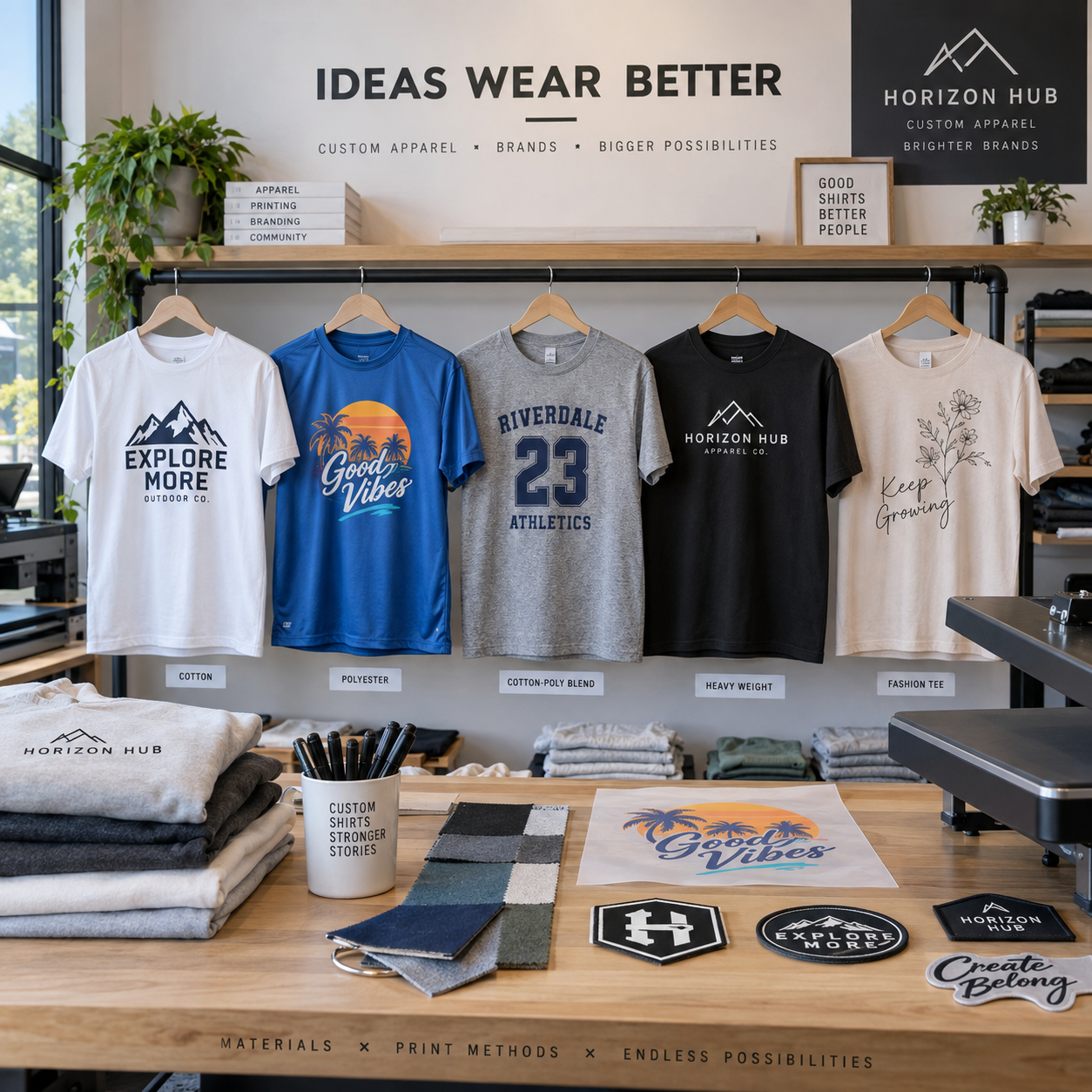
Fabric composition, texture, stretch, thickness and garment construction can all affect the finished result.
For that reason, the shirt and printing method should be considered together rather than separately.
Custom T-Shirt Printing at Horizon Hub
Horizon Hub provides custom apparel printing for individuals, businesses, schools, organizations and events.
Depending on the artwork, garment and quantity, we can recommend an appropriate production method for the project.
Custom apparel can be prepared for:
- Business and company logos
- Staff and work shirts
- Birthday parties
- Family events
- Schools and student groups
- Sports teams
- Community organizations
- Fundraisers
- Promotional campaigns
- Conferences and corporate events
- Clubs and volunteer groups
- Custom gifts
Need help preparing your logo?
If you already have a print-ready logo, it can be reviewed for the selected apparel method.
If your artwork needs preparation, Horizon Hub can also help create, clean up or adapt a logo or design for apparel printing.
This is useful when the original artwork is low resolution, contains unnecessary backgrounds or was created only for online use.
Small quantity or larger order?
Custom apparel does not always have to mean hundreds of shirts.
For certain projects, DTF or HTV can make smaller personalized quantities practical. Larger orders can be reviewed separately to determine the most efficient production method.
The best approach depends on the number of garments, number of designs, print locations, colours and garment type.
Final thoughts: DTF or another printing method?
DTF has become popular because it offers an excellent combination of full-colour capability, durability and flexibility across many apparel projects.
However, it is not automatically the best method for every job.
HTV can be ideal for simple personalization. Screen printing can be excellent for larger repeated orders. Sublimation is hard to beat for compatible polyester products, while DTG provides another strong option for detailed garment printing.
The best result comes from matching the artwork, garment, quantity and intended use with the appropriate production method.
If you are planning custom shirts for your business, birthday party, school, team, office or event, contact Horizon Hub with your logo, quantity and garment details. We can help determine the best approach for your project.