
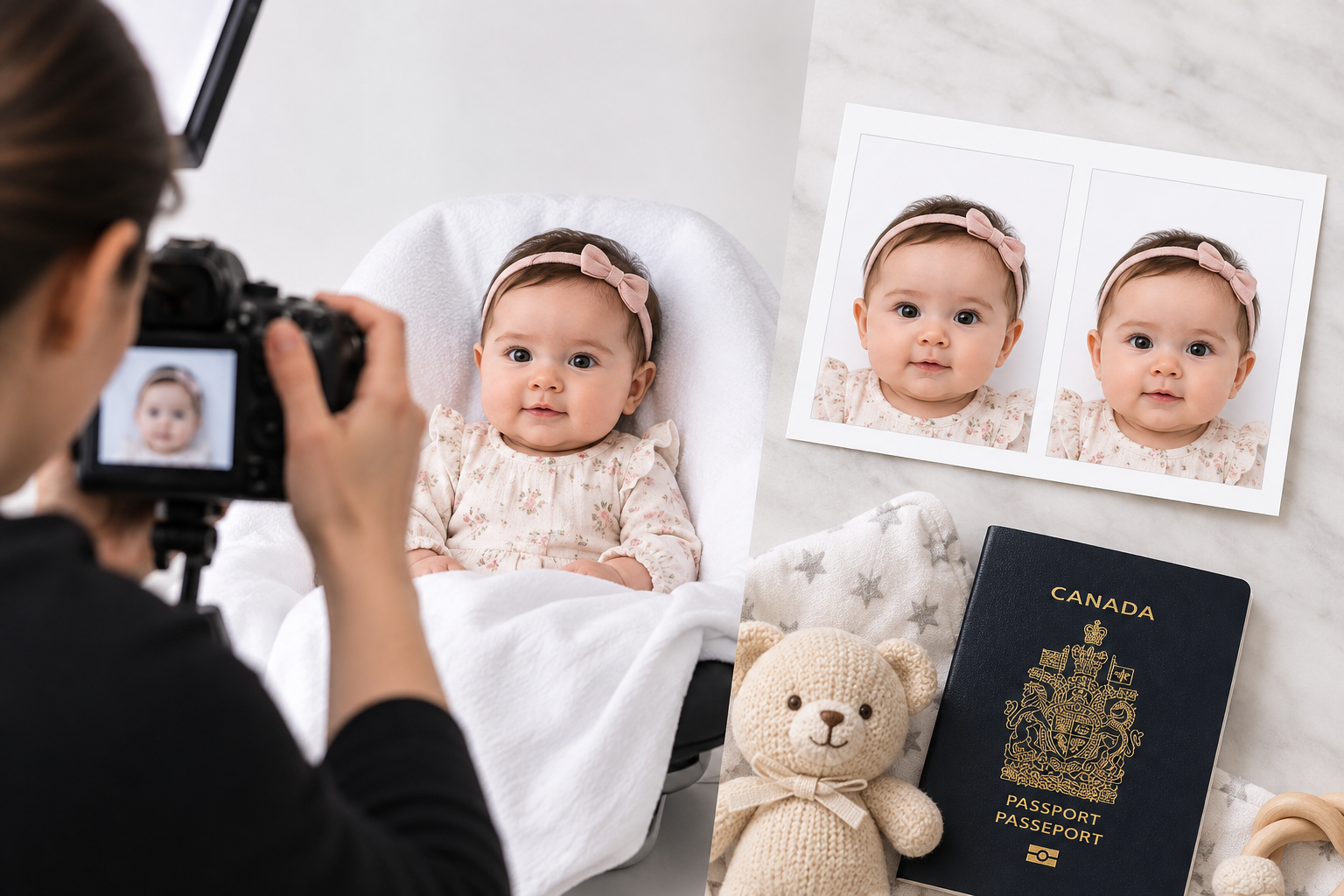
Taking a passport photo of an adult can take only a few minutes. Taking one of a newborn or young baby can require considerably more patience.
Babies move, turn their heads, close their eyes, cry, smile, grab at their clothing and sometimes fall asleep exactly when the photograph needs to be taken.
Passport and immigration authorities understand that photographing a newborn is different from photographing an adult. However, the photograph still needs to meet the technical requirements of the country or immigration program receiving it.
This guide explains what parents should expect when arranging baby passport photos, with particular attention to Canadian passport and Permanent Residence photo requirements.
Are Baby Passport Photo Rules Different From Adult Rules?
Usually, most of the technical requirements remain the same.
The photo still needs appropriate lighting, a suitable background, correct positioning, sufficient image quality and the required dimensions.
However, some issuing authorities allow limited flexibility for very young babies, particularly when it comes to facial expression.
There is no single international baby passport photo size. Every country or immigration authority can establish its own dimensions and submission rules.
That means a photograph prepared for a Canadian passport should not automatically be reused for a U.S., UK, Indian, Pakistani or other passport application without checking the requirements first.
International Passport Photo Principles
Many modern passport systems follow biometric-photo principles associated with International Civil Aviation Organization standards.
In general, a passport photograph should provide a clear and recognizable image of the applicant with:
- The face visible from the front
- Good focus and image quality
- Even lighting
- No distracting shadows
- A simple background
- No other people or unnecessary objects visible
- Facial features clearly identifiable
Individual countries can add their own requirements, so the specifications for the actual application always take priority.
Canadian Baby Passport Photo Size
For a Canadian child passport application, the printed photographs must measure:
50 mm wide × 70 mm high
2 inches × 2¾ inches
The child's face must measure between 31 mm and 36 mm from the bottom of the chin to the crown of the head.
The photograph must be current and taken no more than six months before the passport application is submitted.
How Many Photos Are Needed for a Canadian Child Passport?
For a Canadian child passport application submitted using printed photos, two identical and unaltered photographs are required.
The photos must be taken in person by a commercial photographer or photo studio and professionally printed on proper photographic paper.
Special Rules for Newborn Canadian Passport Photos
The Government of Canada recognizes that getting a perfectly neutral expression from a newborn can be difficult.
Newborns are therefore permitted some flexibility in their facial expression.
A newborn may also be photographed while sitting in a car seat.
If a car seat is used, a plain white blanket should be placed over the seat behind the baby's head. The blanket helps provide a clean background while keeping the baby safely supported.
There must not be shadows around the baby's ears, across the face or shoulders, or on the background.
Can the Parent Hold the Baby?
The final Canadian passport photograph must not show the parent's hands.
The child's hands should also not appear in the photograph.
This is one reason photographing a baby in a properly prepared car seat or another safe supported position can be useful.
A photographer may need a parent close by to comfort or position the child, but the parent cannot remain visible in the final photograph.
What About Older Babies and Toddlers?
Once the child is beyond the newborn stage, parents should prepare for the normal passport-photo expression requirements as much as reasonably possible.
The goal is generally:
- Eyes open and visible
- Looking toward the camera
- Mouth closed
- No large smile or exaggerated expression
- Head facing forward
- Face and shoulders centred
Young children can take longer than adults because the photographer may need several attempts before capturing the right moment.
Baby Passport Photos by Age: What Parents Can Expect
The following groups are practical photography categories rather than official immigration age classifications.
Newborns
Newborn sessions generally require the most patience. The baby may need to be supported in a car seat or photographed during a short calm period between feeding and sleeping.
For Canadian passport photos, some variation in the newborn's facial expression is permitted.
Young Infants
Babies who can hold their head more steadily are often easier to position, but they may still turn toward a parent, smile or move suddenly.
Having a parent stand near the camera can sometimes help the child look forward while the photographer takes the photograph.
Toddlers
Toddlers may understand simple instructions but often have very little patience.
The photographer may work quickly and take several photographs while encouraging the child to look toward the camera without creating an exaggerated smile.
Older Children
Older children normally follow essentially the same posing requirements as adults. Their face should be straight toward the camera with a suitable neutral expression and clear visibility of the facial features.
Canadian Permanent Residence Photos for Babies and Children
Canadian Permanent Residence and PR-card photos also have specific requirements.
For a printed PR photo, the standard dimensions are:
50 mm × 70 mm
The face measurement from chin to crown must be between 31 mm and 36 mm.
For online PR applications, the Government of Canada currently requires a professional digital photograph within its specified pixel dimensions and file-size limits.
The image must still originate from a commercial photographer or photo studio.
Digital Canadian PR Photo Requirements
For applicable online Permanent Residence submissions, the current digital-photo requirements include:
- JPEG or JPG format
- Between 715 × 1000 and 2000 × 2800 pixels
- Maximum file size of 4 MB
- Plain, untextured white background
- Clear and sharp image
- Even lighting
- Natural skin tone
- Face and shoulders centred and facing forward
The photograph must be original and must not be digitally altered.
PR Photo Rules for Newborns
Canadian PR photographs have similar allowances for newborns.
A newborn can be photographed in a car seat with a white blanket placed behind the child's head.
The photograph must not show:
- The parent's hands
- The child's hands
- Hair accessories
- Objects surrounding the baby
- Shadows on the face or background
Newborn babies may have a wider range of facial expressions than older applicants.
Should a Baby Wear White?
For Canadian passport and PR photographs, avoiding white clothing is a good idea because the required background is white or very light.
A medium or darker coloured outfit creates clearer separation between the baby's shoulders and the background.
Simple clothing is preferable.
Avoid:
- Large hoods
- Bulky collars
- Clothing that covers the chin
- Very reflective materials
- Large accessories around the face
Are Hair Accessories Allowed?
For Canadian PR child photographs, the Government of Canada specifically says child photos should avoid hair accessories.
For passport photos, the safest approach is also to keep the baby's appearance simple and keep the entire face clearly visible.
Remove large bows, decorative headbands and similar accessories unless there is a religious or medical reason for a required head covering.
Can Babies Wear Religious Head Coverings?
Daily religious head coverings are generally permitted in Canadian passport and PR photographs as long as the full facial features remain clearly visible and the covering does not create shadows.
Requirements for other countries can differ, so always check the rules for the application being submitted.
What Is the Best Time for a Baby Passport Photo Appointment?
Parents usually know when their baby is most comfortable.
If possible, choose a time when the baby is normally:
- Awake
- Recently fed
- Rested
- Calm
Try to avoid scheduling the session directly during the baby's usual nap time or when the child is likely to be hungry.
Even with good planning, babies do not follow schedules perfectly, so allow some extra time.
Why Baby Passport Photos Are Usually by Appointment
Baby and newborn passport photographs often require more time than adult photos.
The studio may need to prepare the background and lighting, position the baby safely and take several photographs before obtaining an acceptable image.
For this reason, booking an appointment for a newborn or baby passport photo is usually recommended.
An appointment also gives parents time to feed, settle or reposition the baby without feeling rushed.
What Should Parents Bring?
For a baby passport-photo appointment, consider bringing:
- The baby in simple contrasting clothing
- A clean white blanket for newborn positioning if needed
- Diapers and wipes
- Milk or feeding supplies
- A pacifier for calming the baby between photographs
- The official photo instructions if the photo is for a country other than Canada
A pacifier or toy can be used before the photograph to settle the child, but it should not appear in the final image.
Can I Take My Baby's Canadian Passport Photo at Home With My Phone?
Not for a Canadian passport application.
Canadian passport rules require the photograph to be taken in person by a commercial photographer or photo studio.
The Government of Canada also requires the photograph to be original and unaltered.
This means a phone photograph taken at home should not be sent to a business to have the background removed, the baby cut out, the image retouched or the head repositioned for a Canadian passport application.
Those changes can make the photo non-compliant.
Can I Take My Baby's Canadian PR Photo at Home?
For Canadian Permanent Residence and PR-card applications, the photograph is also required to originate from a commercial photographer or studio.
Even when a digital file is uploaded online, it should be a professional digital photograph or an accepted scan of a professional printed photograph.
A normal mobile-phone photograph taken by a parent should therefore not be treated as a substitute for a professionally captured Canadian PR photo.
Why We Do Not Simply Replace the Background
It may seem easy to photograph a baby on a couch or bed and digitally replace the background with white.
For many ordinary photos that is technically possible, but Canadian passport and PR authorities specifically restrict alterations to official identity photographs.
Changing the background, correcting shadows, retouching skin or cutting and pasting the person onto another background may cause the photograph to be rejected.
For official Canadian documents, it is better to capture the photograph correctly from the beginning.
What If My Baby Cannot Come to the Studio?
Some families find it difficult to bring a newborn to a photo studio.
In that situation, ask whether an at-home passport-photo appointment is available.
A photographer can bring the appropriate camera and lighting setup and capture the original photograph at your home while still following the requirements of the intended application.
This is different from a parent taking a casual phone photograph and having it digitally altered later.
Can I Send a Mobile Photo for Other Countries or Applications?
Possibly, but only when the government, embassy, consulate or application system specifically allows applicants to take their own digital photograph.
Some online applications may accept applicant-supplied images while others require a professional photographer.
Before sending a home photograph for processing, check the exact requirements for the country and document.
If self-taken photographs are permitted, a photography or printing service may be able to help check dimensions or prepare the output format, but only within the editing rules allowed by that particular authority.
Never assume that rules for one country's visa or passport also apply to another.
How to Take a Baby Photo at Home When Self-Taken Photos Are Allowed
If the specific application permits a self-taken photograph, these general techniques can help create a better original image.
Use a Plain Background
Place the baby against the background colour required by the application. For very young babies, a clean plain sheet can sometimes provide an even surface if the authority permits this method.
Use Soft, Even Light
Natural window light can work well when it falls evenly across the baby's face.
Avoid harsh direct sunlight and strong overhead lighting that creates shadows.
Do Not Use Flash at Very Close Range
Direct flash can create harsh shadows, red-eye, glare and uneven highlights.
Keep the Camera Straight
Position the camera directly in front of the baby's face rather than photographing from an angle.
Keep the Entire Face Visible
Make sure hair, clothing, blankets, pacifiers and toys are not covering facial features.
Do Not Use Portrait Filters
Disable beauty mode, skin smoothing, artificial background blur, face reshaping and other automatic filters.
Take Several Photographs
Babies move quickly. Take multiple photographs and select the sharpest image with the best forward-facing position.
Do Not Edit an Official Photo Unless the Rules Allow It
This is particularly important for biometric identity photographs.
Do not assume that Photoshop, AI tools or background-removal software can be used simply because the final photograph looks more professional.
For Canadian passport and PR photographs, such alteration is specifically restricted.
The photograph should accurately represent how the child looked when the image was captured.
What If the Baby Is Crying?
There is usually no benefit in forcing the photograph while the baby is extremely upset.
Allow a few minutes for feeding, comforting or calming the child.
For newborn Canadian passport and PR photos, some facial-expression flexibility exists, but an image with the face clearly visible is still important.
Sometimes the best photograph happens during a very short calm moment between expressions.
What If the Baby Is Sleeping?
For most biometric applications, visible open eyes are preferred or required.
Canadian newborns receive some flexibility regarding facial expression, but this should not be interpreted as permission to ignore all other photo requirements.
If possible, schedule the photograph when the baby is awake and calm.
Can a Parent Be Reflected in the Baby's Eyes?
Good passport photography uses controlled lighting and positioning to minimize distracting reflections and glare.
The photographer should focus on producing a clean image that represents the baby's natural appearance.
Why Professional Baby Passport Photography Helps
The challenge is not simply pressing the camera button.
The photographer has to manage:
- Correct camera position
- Background
- Lighting
- Shadows
- Image sharpness
- Head position
- Expression
- Final dimensions
- Printing requirements
- Application-specific specifications
With babies, all of those technical requirements must be achieved while keeping the child comfortable and safe.
Baby Passport and Immigration Photos at Horizon Hub
Horizon Hub provides baby, child and adult passport and immigration photography in our studio.
Baby and newborn appointments are recommended so enough time can be allowed for positioning, feeding or settling the child if needed.
We can prepare photographs for Canadian passports, Canadian Permanent Residence applications and other passport, visa or immigration documents based on the requirements for the specific application.
Where the application requires a digital photograph, we can provide the appropriate professional digital file when permitted by the application requirements.
Where printed photographs are required, they can be prepared at the required dimensions on photographic media.
Home Appointments for Babies
If bringing a newborn to the studio is difficult, contact Horizon Hub to ask about an at-home baby photo appointment.
This allows the photograph to be captured professionally at your location rather than relying on a casual phone image that may not satisfy Canadian passport or PR requirements.
Bring the Requirements for International Applications
If your baby's photograph is for a foreign passport, visa, citizenship application or consular document, tell us the exact country and document type.
If the embassy or application provides its own photo instruction sheet, bring it with you or send it before the appointment.
We can then prepare the photograph according to those specifications rather than assuming every country uses the Canadian format.
Final Advice for Parents
Do not worry if your baby does not cooperate immediately.
Newborn and infant passport photography often takes patience, and it is normal to take several photographs before obtaining the right image.
Choose a time when the baby is likely to be fed and rested, dress the child in simple clothing that contrasts with the background and allow some extra time for the appointment.
Most importantly, use the exact requirements for the document you are applying for. There is no universal international passport-photo size, and Canadian passport and PR applications have particularly specific rules about professional capture and image alteration.