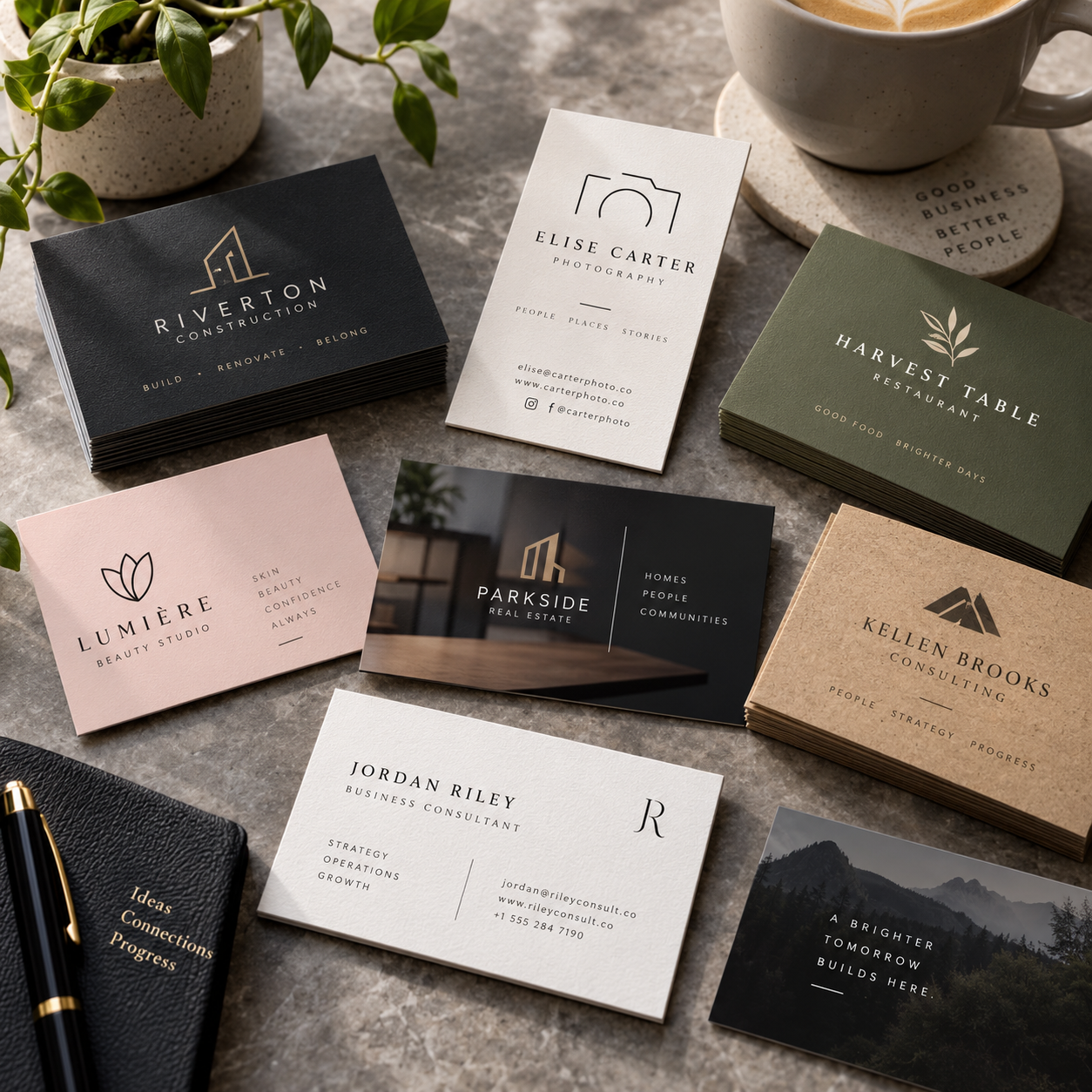
A business card may be small, but the paper, thickness, finish and design can say a lot about a business before a customer ever visits your website or places an order.
Two business cards can contain exactly the same logo and contact information yet feel completely different. A basic matte card can look clean and professional, while a thick soft-touch card with Spot UV can create a much more premium impression.
This guide explains the most common business card sizes, paper stocks and finishing options used in Canada and helps you decide what makes sense for your business.
Do Business Cards Still Matter?
Yes. Websites, social media and QR codes have changed how businesses connect with customers, but a physical business card still provides something digital contact information cannot fully replace: an immediate item that one person can hand directly to another.
A business card is useful at meetings, trade shows, networking events, job sites, stores, restaurants, community events and everyday conversations.
It can quickly communicate:
- Your business name
- Your name and position
- Phone number
- Email address
- Website
- Business address
- Social-media information
- A QR code
- Your main service or message
A well-designed card also gives the customer something physical to keep after the conversation is over.
What Is the Standard Business Card Size in Canada?
The most common standard business card size in Canada is:
3.5 inches × 2 inches
This size fits comfortably into most wallets, card holders and business-card organizers.
It can be designed horizontally or vertically. Both orientations use the same basic card size; only the design direction changes.
Are Other Business Card Sizes Available?
Yes. A business card does not have to use the traditional rectangular format.
Other possibilities can include:
- Square business cards
- Mini cards
- Narrow cards
- Folded business cards
- Custom-shaped cards
- Rounded-corner cards
An unusual size can attract attention, but standard 3.5 × 2 inch cards remain practical because people already know where to store them.
If the card is unusually large, it may look impressive but become inconvenient to carry. The shape should support the purpose of the card rather than being different only for the sake of being different.
Understanding Business Card Thickness
Business card stock is often described using points, usually written as pt.
Examples include:
- 14pt
- 16pt
- 18pt
- 20pt
- 24pt
- 32pt and other extra-thick constructions
A higher point measurement generally indicates a thicker card, although the final feel can also be affected by coating, lamination and the construction of the stock.
Do not confuse point thickness with paper weight. Terms such as GSM, pounds and points describe different properties and should not be treated as exact conversions without knowing the particular paper.
14pt Business Cards
14pt is a common standard business-card thickness.
It is suitable for many everyday applications where the customer wants a professional card without moving into more expensive premium materials.
14pt cards can work well for:
- Small businesses
- Startups
- Sales representatives
- Community organizations
- Events
- High-volume distribution
If you regularly give away a large number of cards, a good standard stock can provide an effective balance between quality and cost.
16pt Business Cards
16pt cardstock feels more substantial in the hand and is a popular step up from standard stock.
It works especially well when you want the card to have a little more presence without becoming unusually thick.
Many premium finishing processes, including certain UV and laminated card products, are commonly produced using a stock in this general thickness range.
18pt, 20pt and Thicker Business Cards
Thicker cards provide a more substantial feel and are often selected when presentation is particularly important.
They can work well for:
- Consultants
- Real-estate professionals
- Law firms
- Financial professionals
- Designers
- Luxury brands
- Construction companies
- Photography businesses
- Premium service providers
Very thick cards can also use layered paper, coloured edges or other specialty construction methods.
Is a Thicker Business Card Always Better?
No.
Thickness is only one part of the final result.
A clean design printed properly on a good standard stock can look far more professional than an expensive thick card with poor typography, weak artwork or too much information.
The paper, design and finish should work together.
Matte Business Cards
Matte is one of the most versatile business card finishes.
A matte card has little or no strong reflective shine, giving it a clean and contemporary appearance.
Matte works particularly well for:
- Corporate cards
- Professional services
- Minimalist designs
- Dark backgrounds
- Modern branding
- Cards containing a lot of text
Because there is less glare than on a glossy surface, text is usually easy to view under different lighting conditions.
Glossy Business Cards
Glossy cards have a more reflective surface.
A gloss finish can increase the visual impact of:
- Photography
- Bright colours
- Food images
- Product photographs
- Colourful artwork
This makes gloss a good option for businesses such as restaurants, photographers, beauty services, automotive businesses and other companies that rely heavily on imagery.
The trade-off is that highly coated glossy surfaces can be difficult to write on with an ordinary pen.
Matte vs Gloss: Which Is Better?
Neither is automatically better.
Choose matte when you want a refined, clean and low-glare appearance.
Choose gloss when vivid photography and bright visual impact are more important.
For many businesses, the design itself will tell you which finish makes more sense.
Uncoated Business Cards
Uncoated paper has a more natural paper feel because it does not have the same smooth glossy coating found on many coated cards.
It is particularly useful when someone needs to write on the business card.
Examples include:
- Appointment cards
- Next-visit reminders
- Loyalty cards
- Personal notes
- Referral cards
Uncoated stocks can also work beautifully with minimalist, organic and handcrafted brands.
Because ink interacts differently with an absorbent uncoated surface, colours may appear softer than they do on highly coated stock.
What Is Soft-Touch Lamination?
Soft touch is a premium finish with a smooth, velvety feel.
It changes the tactile experience of the card immediately. Instead of feeling like ordinary coated paper, the surface has a softer finish that people notice when they pick it up.
Soft touch can work particularly well with:
- Black cards
- Minimalist layouts
- Luxury brands
- High-end service companies
- Premium photography
- Spot UV
- Foil details
The additional finishing increases production cost, so it normally makes the most sense when the physical impression of the card is important to the brand.
What Is UV Coating?
UV coating is a glossy coating cured using ultraviolet light during the production process.
It can create a smooth, highly reflective finish and can make colours appear richer and more visually intense.
There are two terms that customers often confuse:
- Full UV coating
- Spot UV
They are not the same thing.
Full UV Business Cards
With a full UV finish, the glossy coating is applied across most or all of the finished card surface.
The result is a shiny card with strong colour and a polished appearance.
This can work well for:
- Photography
- Automotive businesses
- Restaurants
- Product-based companies
- Colourful promotional cards
If you prefer a very low-glare or natural paper appearance, a full UV coating may not be the best option.
What Is Spot UV?
Spot UV applies a transparent glossy effect only to selected areas of the business card.
For example, the main card can have a matte or soft-touch surface while UV gloss is applied only over:
- The logo
- Company name
- Initials
- A pattern
- An icon
- A selected graphic element
When light hits the card, those selected elements become noticeably shinier than the surrounding surface.
This contrast between matte and gloss is what gives Spot UV its premium appearance.
Why Use Spot UV?
Spot UV is useful when you want to attract attention without making the entire card shiny.
A simple black card, for example, can use a subtle black design with transparent Spot UV over the logo. From one angle the card looks minimal; when the light moves across it, the logo becomes visible through the gloss.
This can create a sophisticated effect without adding many extra colours.
What Is Raised Spot UV?
Raised Spot UV takes the same idea further by creating a thicker, tactile gloss effect.
The selected design can be both seen and physically felt.
Raised finishes can be excellent for premium logos, lettering and patterns where texture is part of the design.
Spot UV Works Best as an Accent
One of the most important design principles with Spot UV is restraint.
The finish usually creates more impact when it highlights selected areas rather than covering every part of the card.
If everything is special, nothing feels special.
A logo, short word, geometric pattern or selected design detail is often enough.
What Is Foil on a Business Card?
Foil adds a reflective metallic or specialty effect to selected artwork.
Popular examples include:
- Gold foil
- Silver foil
- Metallic colours
- Raised foil
Foil can work particularly well for premium brands, invitations, real estate, beauty businesses, fashion, jewellery and luxury services.
Like Spot UV, foil usually works best when it is used selectively.
Textured Business Cards
Some businesses prefer the texture of the paper itself to be a major design element.
Options available in the Canadian market can include:
- Cotton stocks
- Linen-like stocks
- Natural textured papers
- Recycled stocks
- Kraft stocks
- Premium uncoated papers
These stocks can work especially well for photographers, architects, handmade-product businesses, wellness brands, artists, designers and environmentally focused companies.
Kraft Business Cards
Kraft cards use a naturally brown or recycled-looking material.
They can create a strong organic, handmade or industrial appearance.
However, the colour of the paper becomes part of the design. Standard process inks are not completely opaque, so colours can appear different when printed over a brown substrate.
Some specialty production workflows can use white ink underneath selected artwork when required.
Rounded Corners or Square Corners?
Standard business cards normally have square corners, but rounded corners provide another subtle way to differentiate the card.
Rounded corners can feel:
- Modern
- Friendly
- Contemporary
- Less formal
Square corners usually provide a more traditional and straightforward appearance.
Neither option is universally better. Choose the one that matches the brand.
Single-Sided or Double-Sided Business Cards?
Using both sides gives you considerably more room without increasing the physical size of the card.
A practical layout might use:
Front:
- Logo
- Company name
- Brand message
Back:
- Name
- Position
- Phone
- Website
- QR code
Another approach is to put all essential contact information on one side and use the reverse for services, an appointment area or a QR code.
Should You Put a QR Code on a Business Card?
A QR code can be useful when it has a clear purpose.
It can direct customers to:
- Your website
- Online portfolio
- Booking page
- Restaurant menu
- Contact information
- Social-media profile
- Google review page
- Digital business card
Do not make the QR code unnecessarily small. It should have enough clear space around it and should always be tested with multiple phones before printing the full quantity.
What Information Should Be on a Business Card?
A business card does not need to contain every piece of information about your company.
At minimum, consider including:
- Logo
- Business name
- Your name
- Your position, if relevant
- Phone number
- Email or website
Then add other information only when it serves a purpose.
A crowded business card can become harder to read and may look less professional than a simple card with good spacing.
What Makes a Business Card Look Professional?
Professional design is not about filling every empty space.
Strong business cards normally have:
- A clear visual hierarchy
- Readable typography
- Good spacing
- A high-quality logo
- Consistent brand colours
- Correct alignment
- Enough contrast
- High-resolution or vector artwork
The customer should be able to identify the company and find the important contact information quickly.
Why Vector Logos Are Better for Business Card Printing
Logos should ideally be supplied as vector artwork when possible.
Vector artwork remains sharp regardless of size and generally produces cleaner edges for logos, typography and line graphics.
Files such as AI, EPS, SVG or a properly created vector PDF are preferable to screenshots or small JPG images.
If the only available logo is a low-resolution image taken from a website or social-media account, it may need to be recreated before professional printing.
Business Card Bleed and Safe Area
Professional printing requires allowance for normal cutting tolerances.
If a colour or image reaches the edge of the finished card, the artwork needs to extend beyond the trim line into the bleed.
A common print-design bleed is approximately 1/8 inch, although the exact requirement should always follow the printer's template.
Important text, phone numbers and logos should also remain safely inside the trim edge.
Do not place essential information directly against the cutting line.
What Resolution Should Business Card Artwork Use?
Photographs and other raster images should normally be prepared at sufficient resolution for the final print size. Approximately 300 pixels per inch at final size is a common target for small-format commercial printing.
Logos, icons and text should preferably remain vector where practical.
What Is the Best Business Card?
There is no single best card for every business.
| Requirement | Good Option to Consider |
|---|---|
| Affordable everyday card | Standard matte or gloss |
| Professional corporate card | Matte on a sturdy stock |
| Photography or colourful artwork | Gloss or high-gloss finish |
| Appointment or writable card | Uncoated stock or writable reverse |
| Premium modern appearance | Soft touch |
| Premium logo highlight | Soft touch with Spot UV |
| Tactile premium effect | Raised Spot UV or raised foil |
| Luxury branding | Thicker stock with foil or specialty finish |
| Natural or handmade branding | Uncoated, kraft or textured stock |
Simple Business Cards Can Still Look Excellent
You do not need an expensive specialty finish to have a professional card.
A well-designed standard card with clean typography, good spacing and quality printing can be exactly what many businesses need.
Simple cards are particularly practical when:
- You distribute a large quantity
- Contact details change frequently
- You are starting a new business
- You need multiple employee versions
- You prefer a clean minimalist look
When Is a Premium UV Card Worth It?
A premium UV or Spot UV business card makes sense when the card itself is part of the presentation of your business.
For example, a designer, builder, photographer, realtor, consultant or premium service company may want a card that customers immediately notice when they hold it.
Spot UV can highlight a logo without making the design unnecessarily complicated.
Premium finishing does not replace good design. It should enhance the design that is already there.
Advantages of Having a Business Card
A physical business card remains useful for several reasons.
1. It Makes Sharing Contact Information Easy
You can hand someone your complete contact information within seconds without asking them to type your name or search for your company.
2. It Creates a Physical Reminder
A person may put your card in a wallet, vehicle, office or desk and see the company name again later.
3. It Helps Present a Consistent Brand
Your logo, typography, colours and contact information can match your website, signage, vehicle graphics and other marketing materials.
4. It Works Without a Phone or Internet Connection
A business card does not depend on battery life, cellular service or Wi-Fi.
5. It Can Support Digital Marketing
A QR code or website address can connect the physical card directly to your online presence.
6. It Is Useful for Local Businesses
Contractors, realtors, restaurants, photographers, consultants, tradespeople, service businesses and many other local professionals regularly meet potential customers face to face.
A business card provides an easy way to continue that connection after the conversation.
Business Card Printing in Regina, Saskatchewan
Horizon Hub provides business card design and printing in Regina, Saskatchewan for businesses, organizations and professionals.
Whether you need a straightforward everyday business card or something more premium, we can help select a card style that works with your design and budget.
Options can include standard cards as well as premium finishes such as UV or specialty cards depending on the project and current production options.
We can also help with:
- Business card design
- Logo preparation
- Double-sided layouts
- QR codes
- Print-ready file preparation
- Multiple employee cards
- Premium business card options
Need Business Cards but Do Not Have a Design?
You do not need to arrive with a finished professional file.
If you already have a logo and business information, Horizon Hub can prepare a clean business card layout for you.
If your existing logo is low resolution or not suitable for printing, we can review the artwork and advise whether a higher-quality file or logo recreation is required.
Already Have a Business Card Design?
If your artwork is already prepared, send us the print-ready file for review.
For professional production, PDF or vector artwork is preferred where appropriate. The file should use the correct dimensions, bleed, safe area and adequate image resolution.
If you are unsure whether your file is print-ready, we can check it before the order is produced.
Final Advice
When choosing a business card, do not choose paper based only on thickness or price.
Think about how the customer will use the card and what impression your business should create.
A standard matte card may be exactly right for a business that distributes hundreds of cards. A writable uncoated card may make more sense for appointments. A photographer may prefer a glossy card for strong imagery, while a premium brand may benefit from soft touch, Spot UV or foil.
The best business card is the one where the design, material, finish and purpose all work together.
If you need business card printing in Regina or want help comparing standard and premium business card options, contact Horizon Hub and we can help you choose an appropriate option for your project.