A passport photo may look simple, but it is an identity photograph used for official documents and biometric identification. The size of the photo, position of the face, background, lighting, expression and even what you wear can affect whether the image is accepted.
One of the most important things to understand is that there is no single passport photo size or rule used by every country. Canada, the United States, the United Kingdom, India and other countries can have different specifications.
For that reason, your passport photo should always be prepared according to the current requirements of the country, embassy, consulate, immigration program or application you are submitting.
What should you wear for a passport photo?
For most passport and immigration photos, simple everyday clothing works best.
A plain shirt, blouse, sweater or business-casual top usually photographs well. The goal is to make your face clearly distinguishable from your clothing and the background.
For a white or very light background, medium or darker colours are generally the safest choice.
- Navy blue
- Black
- Dark grey
- Burgundy
- Dark green
- Medium blue
- Other solid colours that contrast with the background
Should you wear white for a passport photo?
It is usually better to avoid a white or very light-coloured shirt when the passport photograph requires a white or light background.
If your clothing blends into the background, the outline of your shoulders may become less distinct.
Some passport authorities specifically recommend avoiding white clothing for this reason.
If possible, wear a medium or dark-coloured top so there is clear separation between you and the background.
Can you wear patterned clothing?
Simple patterns may be acceptable for many applications, but plain clothing is generally a better choice.
Large graphics, reflective materials, very bright patterns or complicated designs can distract from the face. Your clothing should not become the main visual element of an identification photograph.
A simple solid-colour top normally produces the cleanest result.
Can you wear a suit or business clothing?
Yes. A suit jacket, blazer, collared shirt or other normal business clothing can usually be worn.
However, some countries restrict uniforms or clothing that resembles an official or military uniform. If you are unsure, ordinary civilian clothing is the safer choice.
Can you wear glasses in a passport photo?
This is one of the areas where country requirements differ.
For the safest result, we generally recommend removing your glasses unless they must be worn for a medical reason or the application specifically permits them.
For example, current U.S. passport requirements normally require eyeglasses to be removed. Medical exceptions may require supporting documentation.
Canada currently permits regular eyeglasses if the eyes are completely visible and there is no glare on the lenses. Sunglasses and tinted lenses are not accepted.
UK guidance says glasses should not normally be worn unless they need to be worn. If they are necessary, the eyes must remain clearly visible without glare, reflections or frames obstructing them.
Because rules vary, removing ordinary glasses often reduces the risk of reflections, glare or an application being rejected.
Are sunglasses allowed?
Normally, no.
Sunglasses and dark or tinted lenses are generally unsuitable for passport photographs because the eyes must be clearly visible for identification.
Medical exceptions may exist in some jurisdictions, but they can require additional documentation.
Can you wear a hijab or religious headscarf?
Religious head coverings are accepted by many passport authorities, provided the face remains clearly visible.
A hijab, turban or other religious head covering should be positioned so that it does not cover the important facial features required for identification.
The covering should also not create shadows across the face.
Where possible, avoid a white head covering against a white background because the edges of the covering may blend into the background.
Requirements can vary by country. Some authorities may also request an explanation or statement confirming that the head covering is worn for religious purposes.
Can you wear a hat or cap?
Ordinary fashion hats, baseball caps, winter hats and similar headwear should normally be removed.
Exceptions are commonly made for religious or medical reasons, but the full face must remain visible and the head covering must not cast unacceptable shadows.
What about a scarf around the neck?
A normal scarf may be acceptable if it does not cover the chin, jawline or important facial features.
However, bulky scarves, high collars and clothing that comes very close to the chin can make the outline of the face and neck less clear.
For an identification photograph, simpler clothing is usually the safer choice.
Can hair cover the face?
Your hairstyle does not have to be changed simply for a passport photograph, but your eyes and important facial features need to remain clearly visible.
Keep long bangs or loose hair away from the eyes and avoid hairstyles that create heavy shadows across the face.
Can you smile in a passport photo?
Most passport authorities require a neutral or natural expression.
Typically, you should:
- Look directly at the camera
- Keep your eyes open and visible
- Keep your mouth closed
- Keep your head straight
- Avoid exaggerated smiling or frowning
A passport photograph is different from a portrait or social-media photograph. The purpose is reliable identification rather than creating a particular pose.
Passport photo sizes are different around the world
The term "passport size" does not describe one universal measurement. Different governments use different dimensions and different head-position requirements.
| Country / Application | Common Printed Photo Size | Important Note |
|---|---|---|
| Canada Passport | 50 × 70 mm | Face height and photographer requirements also apply. |
| United States Passport | 51 × 51 mm / 2 × 2 inches | Head position and head size must meet U.S. requirements. |
| United Kingdom Passport | 35 × 45 mm for printed applications | Digital applications have separate digital-image specifications. |
| India | Requirements depend on the application and processing location | Current Indian passport and consular instructions should be checked before preparing the photo. |
| Other Countries | Varies | Check the current embassy, consulate or immigration requirements. |
The finished dimensions are only one part of the requirement. Authorities can also specify the distance from the chin to the top of the head, eye position, amount of space around the head, background colour and digital resolution.
Canada passport photo requirements
Canadian passport photos are different from the standard 2 × 2 inch format used by the United States.
For a Canadian passport application, printed photographs are 50 mm wide by 70 mm high. The face from the bottom of the chin to the crown of the head must also fall within the required measurement range.
Canadian photos require a plain white or light-coloured background, proper lighting, a neutral expression and a clear view of the face.
Canada currently permits normal prescription glasses if the eyes are completely visible and there is no glare. Tinted glasses and sunglasses are not accepted.
United States passport photo requirements
U.S. passport photos are 2 × 2 inches, or approximately 51 × 51 mm.
The applicant must face the camera directly with the head centred and correctly sized within the photograph.
Ordinary eyeglasses should be removed for U.S. passport photos. Hats and head coverings are generally removed unless they are required for religious or medical purposes.
The U.S. also restricts uniforms, clothing that looks like a uniform and camouflage clothing in passport photographs.
UK passport photo requirements
Printed UK passport photos measure 35 mm wide by 45 mm high.
The photograph must show the head and upper shoulders clearly, with the applicant looking directly at the camera and maintaining a plain expression.
Head coverings are permitted for religious or medical reasons as long as they do not hide the face.
Glasses should normally be removed unless they need to be worn. If glasses are necessary, the eyes must remain visible and there must be no glare or reflections.
What background is used for passport photos?
Background requirements vary, although white and light neutral backgrounds are common.
The background must normally be plain and free from:
- Shadows
- Patterns
- Furniture
- Other people
- Objects
- Visible texture that interferes with the image
Do not assume every country uses exactly the same background colour. The correct background should be selected according to the application requirements.
Can a passport photo be edited?
Passport and immigration photographs should represent how you actually look.
Beauty filters, AI facial alterations, reshaping facial features, changing skin appearance or replacing important parts of the image can make an official photograph unacceptable.
Some authorities are particularly strict about digital alteration.
Professional passport photography is therefore very different from portrait retouching. The goal is an accurate, compliant identity photograph.
Should you wear makeup?
Normal everyday makeup is generally not the same as digitally altering an image, but it is best to keep your appearance natural and recognizable.
Avoid anything that dramatically changes the appearance of your normal facial features.
What about jewellery and facial piercings?
Small jewellery is often acceptable if it does not cover or obscure the face.
However, very large, reflective or distracting accessories may create glare or interfere with facial visibility. When in doubt, keep accessories simple.
What should babies and children wear?
Simple clothing with good contrast against the required background is also recommended for children.
Passport authorities often have special allowances for infants and young children regarding facial expression and eye direction, but requirements vary by country.
The child normally needs to appear alone in the finished photograph. Parents, hands, toys, pacifiers and other objects generally should not appear unless the applicable authority specifically allows something different.
What should you bring to a passport photo appointment?
If you are applying for something other than a standard Canadian passport, it is helpful to tell the photographer exactly what the photo will be used for.
Bring or provide the application instructions if you have them, especially for:
- Foreign passports
- Visa applications
- Permanent residence applications
- Citizenship documents
- Work permits
- Study permits
- Foreign consulate applications
- Immigration documents
- Professional licensing applications
Printed passport photo or digital passport photo?
Not every application requires the same format.
Some authorities still require professionally printed photographs, while others accept or require digital files.
A digital photo may also have requirements for pixel dimensions, file size, file type and image quality in addition to the normal facial-position requirements.
Always confirm whether your application needs printed photos, a digital file or both.
How to reduce the chance of a passport photo being rejected
- Tell the photographer which country or application the photo is for.
- Wear clothing that contrasts with the required background.
- Avoid white clothing when a white background is required.
- Remove ordinary glasses when possible.
- Do not wear sunglasses or tinted lenses.
- Remove ordinary hats and caps.
- Keep religious head coverings positioned so the full face remains visible.
- Keep hair away from the eyes.
- Look directly at the camera.
- Use the expression required by the issuing authority.
- Do not use beauty filters or AI alterations.
- Check the current requirements before submitting your application.
Passport and Immigration Photos at Horizon Hub
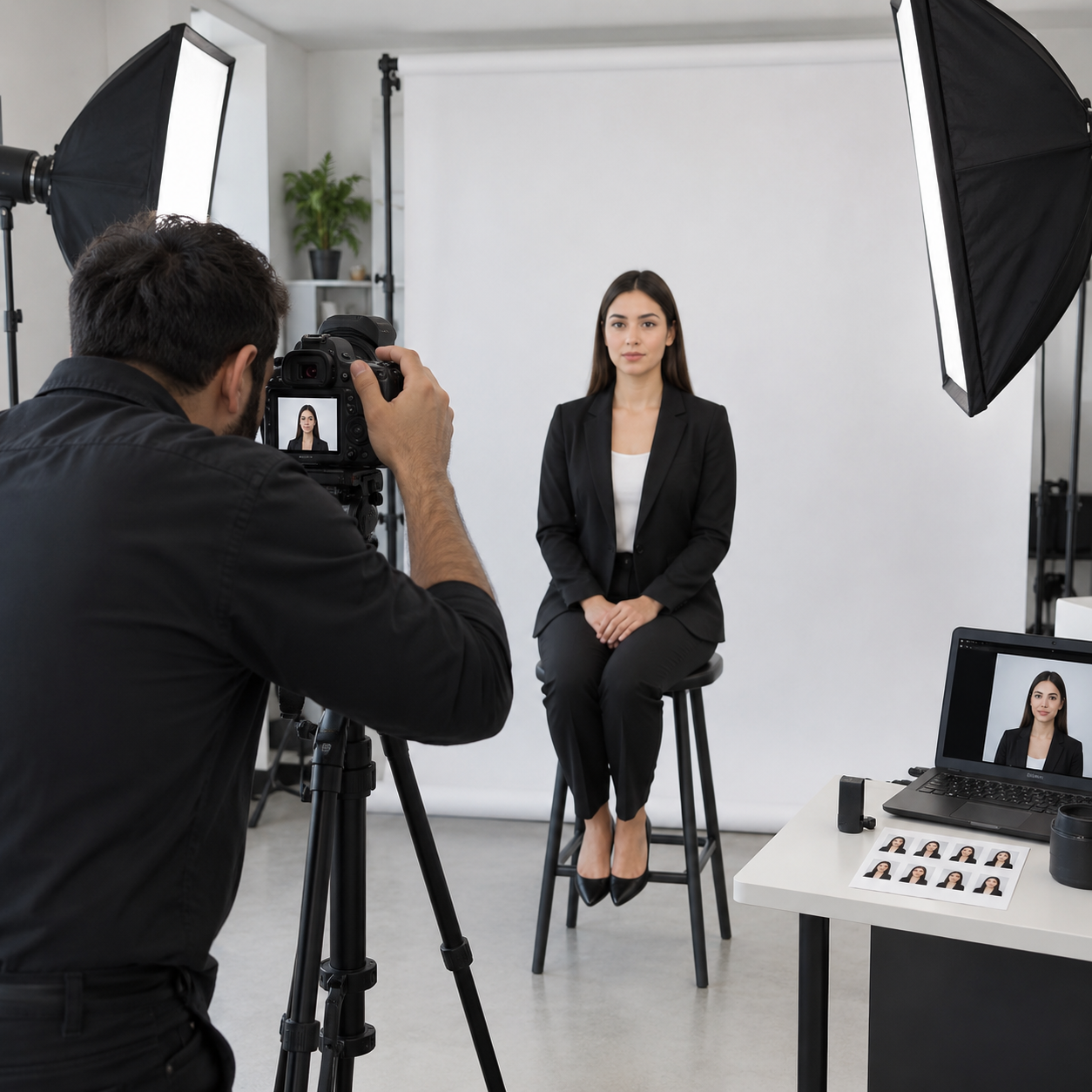
Horizon Hub provides professional passport, visa and immigration photography in our studio.
We prepare photos according to the requirements of the application rather than using one generic "passport size" for every customer.
Services can include photos for Canadian passports, U.S. passports, UK passports, Indian passports and consular applications, Pakistani documents, visas, permanent residence and other immigration-related applications.
Printed photos and digital files can be prepared where required by the application.
For the best result, tell us the country and exact document you are applying for when you book or visit the studio. If you have official photo instructions from an embassy, consulate or application form, bring them with you and we can prepare the photograph according to those specifications.
Final advice
The best passport-photo outfit is usually simple: a medium or dark solid-colour top, minimal accessories and nothing that hides the face.
However, clothing is only one part of a compliant passport photo. Size, head position, background, lighting, expression and application-specific rules are equally important.
Because requirements can change, always use the current instructions from the government, embassy, consulate or immigration authority handling your application.